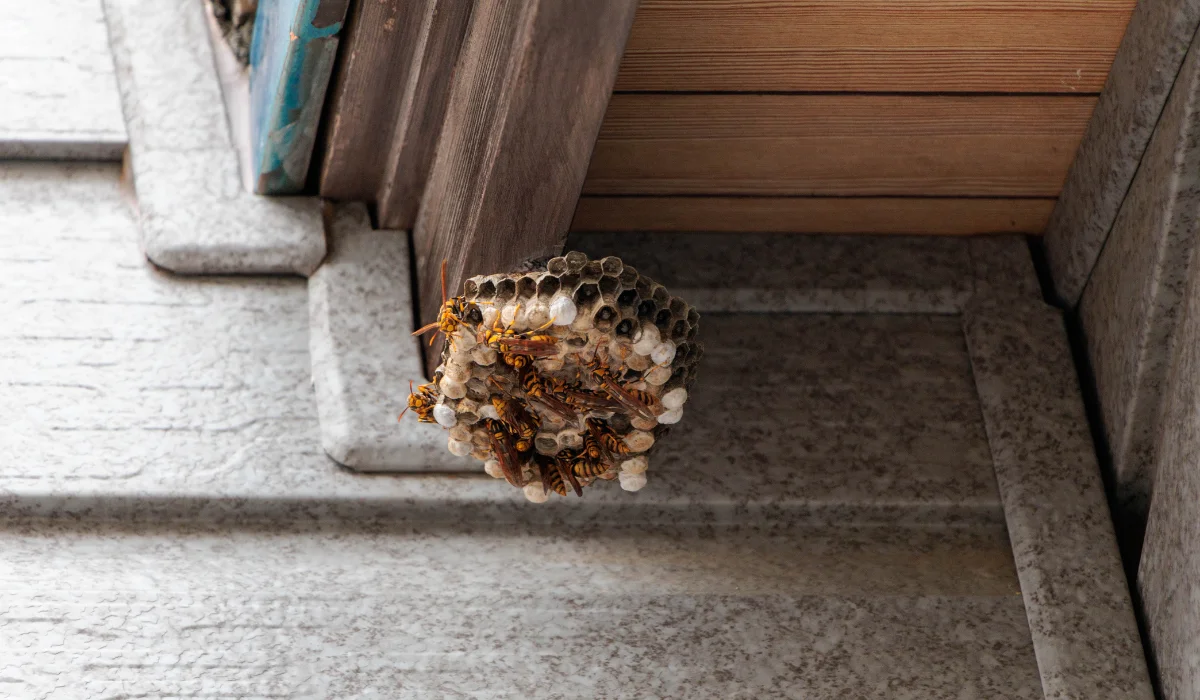
A wasp nest under an eave can be easy to miss until the traffic becomes steady. You may see wasps tracing the same path along the roofline, gathering under a patio cover, or slipping behind a soffit where the nest is partly hidden.
For San Diego homeowners trying to understand how to get rid of a wasp nest in eaves San Diego homes, the safest first step is distance.
Do not knock the nest down, spray it from a ladder, or seal the opening while wasps are active. Thrasher Pest Control can inspect the area, confirm where the nest is active, and treat the source safely.
Key Takeaways
- Do not knock down or spray a wasp nest in your eaves from close range.
- Watch for steady wasp traffic near the same roof edge, soffit, or overhang.
- Keep people and pets away from the area until the nest is checked.
- Eave nests can be visible or partly hidden behind trim, fascia, roofline gaps, or climbing plants.
- Professional treatment is safest when the nest is active, high, or hard to reach.
Why Wasps Build Nests in Eaves
Eaves give wasps shade, shelter, and a firm place to attach a nest. They also keep the nest partly protected from wind, rain, and daily activity around the home.
In San Diego, homeowners often notice wasp nests around:
- Roof edges
- Soffits and fascia boards
- Patio covers and pergolas
- Second-story overhangs
- Garage eaves
- Porch ceilings
- Gaps near vents or exterior trim
The nest may look like a small paper umbrella, a gray enclosed structure, or a hidden entry point where wasps keep disappearing into a gap. California’s UC IPM guide to yellowjackets and other social wasps notes that paper wasps often hang nests in protected areas such as under eaves, while some aerial-nesting yellowjackets attach paper nests to building eaves or enter wall voids through holes or vents in the eaves.
How to Tell If the Nest Is Active
An active eave nest usually has steady movement. You do not need to see the full nest to know there is a problem.
Look from a safe distance during daylight and watch for:
- Wasps flying in and out of the same spot.
- Wasps gathering on the outside of a visible nest.
- Activity near a soffit, fascia gap, or roofline opening.
- Activity in and out of climbing plants.
- A nest that appears to be growing over time.
- Wasps becoming defensive when people walk near the area.
A single wasp near the roofline does not always mean there is a nest. Repeated traffic in one exact area is a stronger sign that wasps are nesting there.
What Not to Do With a Wasp Nest in Eaves
Eave nests are often difficult to reach, and disturbing them can make wasps defensive. Ladders also make the situation riskier because a sting or sudden movement can lead to a fall.
Avoid these actions:
- Do not hit the nest with a broom, hose, or pole.
- Do not stand under the nest to inspect it.
- Do not seal a roofline gap while wasps are active.
- Do not use a ladder to spray the nest yourself.
- Do not let children or pets play near the area.
- Do not assume the nest is inactive because you only see wasps at certain times.
If the nest is inside a soffit or wall void, sealing the opening can push wasps toward another exit. In some cases, that may send activity deeper into the structure.
What You Can Do Before Help Arrives
You do not need to solve the nest yourself to make the area safer. A few simple steps can reduce contact while you wait for service.
Keep people and pets away from the eave where wasps are active. Move patio chairs, toys, trash bins, and pet bowls away from the area if you can do so without getting close to the nest. Keep outdoor food and sugary drinks covered, especially near patios and outdoor dining areas.
If the nest is near a door, use a different entrance when possible. If activity is close to a balcony, second-story window, or garage, avoid opening and closing nearby doors or windows until the nest is inspected.
When Professional Wasp Control Makes Sense
A visible nest under a low patio cover may seem simple, but wasps can react quickly when the nest is disturbed. Professional help is the better option when the nest is active, elevated, partly hidden, or close to daily activity.
Call for wasp control if:
- The nest is under a second-story eave.
- Wasps are entering a soffit, fascia gap, or wall opening.
- The nest is near a front door, garage, patio, or walkway.
- Someone in the home is sensitive or allergic to stings.
- A gardener has reported wasps or has been stung.
- Wasps are active near children or pets.
- You have tried to avoid the area, but activity is increasing.
Thrasher’s San Diego wasp control service is designed to locate nests around eaves, soffits, overhangs, and yard structures, then treat active nests directly at the source.
How Thrasher Handles Wasp Nests in Eaves
At Thrasher Pest Control, we start by checking the areas where wasps are most likely to build a nest. Around San Diego homes, that often includes eaves, soffits, overhangs, patio covers, and yard structures.
Once we find the active nest, we focus treatment where the wasps are nesting. That matters because visible wasps are only part of the issue. The source is the nest itself.
Our team also checks nearby conditions that may attract new activity, such as protected roofline gaps, shaded structures, and exterior areas where wasps may return. If you are seeing wasps fly to the same eave again and again, we can inspect the activity and recommend the right next step.
Schedule Wasp Control in San Diego
If there is a wasp nest in your eaves, do not risk a ladder, a close-range spray, or a rushed knockdown. Thrasher Pest Control can inspect the activity, locate the nest, and treat the source safely.
Contact us to schedule wasp control in San Diego and get help from a local team that knows where wasps commonly nest around San Diego homes.
Frequently Asked Questions
Can I Remove a Wasp Nest From My Eaves Myself?
It is safer not to. Eave nests can be hard to reach, and wasps often attack when the nest is disturbed. If the nest is active, high, or near people, professional treatment is the better choice.
How Do I Know If a Wasp Nest in My Eaves Is Active?
Watch from a safe distance. If wasps are flying in and out of the same roof edge, soffit, or overhang, the nest is likely active.
Should I Seal the Gap Where Wasps Are Entering?
No. If wasps are nesting behind the eave or inside a void, sealing the gap can trap them and push them toward another exit. Have the nest inspected before closing any openings.
Why Do Wasps Keep Coming Back to the Same Eave?
Eaves offer shade and protection. If the area has a good attachment point, a roofline gap, or nearby food and water sources, wasps may continue returning unless the nest and attractants are addressed.
Does Thrasher Treat Wasp Nests in San Diego Eaves?
Yes. Thrasher Pest Control provides wasp control in San Diego and checks common nesting areas such as eaves, soffits, overhangs, and yard structures.