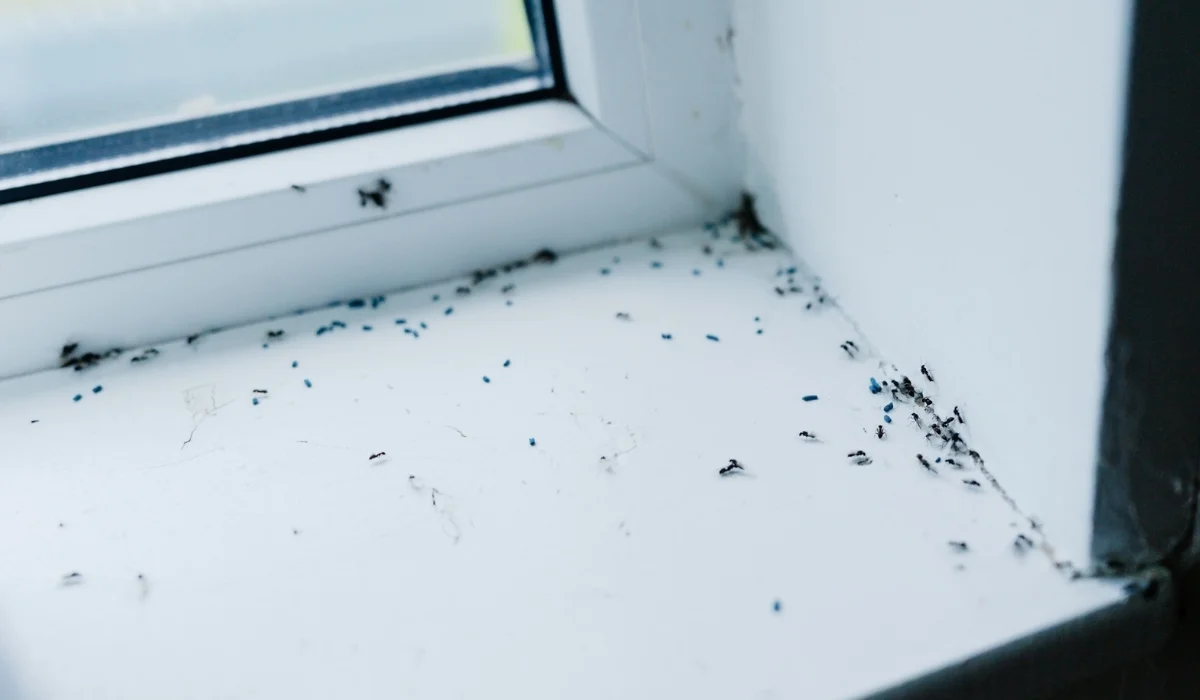
If ants are appearing in different parts of your home without a clear trail, the pattern itself can still reveal useful clues. Thrasher inspectors see this in San Diego homes, where ants may show up near sinks, countertops, windows, or baseboards with no obvious route between them.
Instead of chasing individual ants, the goal is to identify the species, locate the conditions supporting the activity, and trace where the infestation is coming from. That gives you a better path to controlling the colony rather than repeatedly treating the ants that happen to be visible.
What “Scatter Ant” Activity Looks Like in San Diego Homes
Homeowners often expect ants to form one obvious trail from an entry point to food or water. That does not always happen. With some ant activity Thrasher sees around San Diego, the pattern looks scattered instead.
You may notice:
- One ant near the sink and another across the kitchen
- Workers appearing from different cabinet seams
- Ants near a window without a visible trail leading outside
- Activity along several sections of baseboard
- Ants appearing around plumbing, appliances, and food areas at different times
- Workers disappearing through more than one small opening
- Activity moving to another part of the room after the visible ants are cleaned up
That does not necessarily mean the ants are coming from unrelated colonies. They may be scouting, using scent information you cannot see, traveling through concealed spaces, or entering through more than one opening.
How to Get Rid of Ants That Scatter and Don’t Leave a Trail Indoors
Getting rid of ants that scatter and don’t leave a trail starts with observing the pattern before disrupting it. You do not need to watch them for hours. A few specific details can make the infestation much easier to evaluate and help an inspector determine where the activity is coming from.
1. Note Where Ants Repeatedly Appear
Focus on locations where you see activity more than once. Check areas such as:
- Cabinet edges and food-storage areas
- Sinks and nearby plumbing
- Dishwashers and other moisture-prone areas
- Windows and exterior doors
- Baseboards and wall openings
- Pet feeding areas
A recurring location tells you more than the direction one ant runs after being disturbed. If ants appear around the same cabinet seam or plumbing opening every morning, that repeated activity can help narrow down where they are traveling.
The same principle applies when ants turn up outside the usual kitchen or bathroom setting. For example, ants in your car can also be easier to understand when you look for repeated activity, food residue, and the places where workers keep appearing instead of focusing on a single ant.
2. Remove Accessible Food and Correct Moisture Problems
Foraging ants are searching for resources. Crumbs, food residue, accessible pet food, and moisture can keep workers returning to the same part of the home.
Clean food residue and store food in closed containers where practical. If ants repeatedly appear around plumbing, sinks, or another damp area, correct the moisture source rather than treating the ants as a surface-only problem.
These steps will not remove every established colony on their own. They reduce the resources supporting ant activity and make the remaining pattern easier to evaluate.
3. Check the Same Area Outside
When ants repeatedly appear along an exterior wall, window, or doorway, inspect the corresponding area outside. Look for visible ant activity, moisture, openings, and places where workers may be approaching the structure.
This is especially useful when ants disappear through a small indoor gap. The nesting area does not have to be directly behind the place where workers enter the room. Comparing indoor and outdoor activity can reveal a route that is easy to miss when you only look from inside.
4. Use a Colony-Focused Treatment Plan
Baiting is an important part of ant control because it works beyond the individual worker that first encounters it. Foraging ants can carry or transfer bait to other colony members, allowing treatment to reach ants that are not visible on a countertop or floor.
The ant species, bait location, feeding activity, and surrounding conditions all affect the plan. Placing bait without understanding where ants are active produces inconsistent results.
An inspector can determine which areas deserve attention and recommend treatment based on the species and location rather than applying the same approach to every visible ant.
5. Monitor Where Activity Changes
After treatment begins, watch where ants continue to appear. Activity may decline in one area or become noticeable somewhere nearby.
Those changes may reveal another route, food source, moisture condition, or nesting area that was not apparent during the initial inspection. Monitoring gives the inspector useful information for follow-up decisions.
The goal is not to react to every individual worker. It is to determine whether the overall activity is decreasing and whether another part of the structure needs attention.
Why Do Some Ants Scatter Instead of Following an Obvious Trail?
Ants that scatter and don’t leave a trail may still be following scent information. The University of California Statewide Integrated Pest Management Program’s guidance on ants explains that ants use pheromones to communicate, including signals that help recruit workers to food and other resources.
Those scent trails are invisible, so ants can appear to be moving without direction even when they are responding to information left by other workers.
The pattern you see also depends on what the ants are doing at that moment. A few workers searching a kitchen, bathroom, or utility area may move independently before more ants begin using the same route. If food or moisture changes location, the visible traffic can change with it.
Scouting Activity Can Look Random
One ant crossing a countertop does not tell you where the colony is located. The worker may be searching for food, water, or a route through the structure before disappearing behind cabinetry, under an appliance, or through a small opening.
Instead of trying to follow one ant until it disappears, note where activity repeats. Ants that consistently show up near a sink, cabinet seam, window, baseboard, plumbing opening, or exterior door give an inspector a more useful pattern to investigate.
Disturbing Ants Can Break Up the Pattern
Wiping a surface, moving an object, or applying a product directly to visible workers can interrupt the route you were watching. Ants may spread out or retreat into nearby gaps, making the original path harder to recognize.
That reaction is not a reliable way to identify the species. An inspector gets better information from the ants’ size and appearance, where activity occurs, nearby food and moisture, and the areas where workers repeatedly enter or disappear.
Which Ants Could Be Showing Up in a San Diego Home?
Ants that do not form an obvious line cannot be identified by movement alone. Thrasher Pest Control’s Home Pest Protection services cover Argentine ants, carpenter ants, little black ants, odorous house ants, pavement ants, Pharaoh ants, and thief ants, among other common pests.
Several of these species are small enough to be difficult to distinguish at a glance. Location and behavior help narrow the possibilities, but identification should consider more than one clue.
| Ant Type | Behavior or Context Worth Noting | Why Identification Matters |
|---|---|---|
| Argentine ants | Often use noticeable foraging routes | Trails can help locate activity, but movement alone does not confirm the species |
| Pharaoh ants | Colonies can establish new nesting sites through budding | Colony structure affects the treatment approach |
| Odorous house, little black, and thief ants | May appear around food or moisture indoors | Similar-looking ants require closer identification before treatment |
If winged insects begin appearing indoors or around the structure, that creates a different identification question. Flying ants and termites can be confused at a glance, so winged insects should not be assumed to be the same ants you have been seeing on countertops or floors.
Argentine Ants
Argentine ants are well established in California. The UC Riverside Center for Invasive Species Research profile on Argentine ants documents the species in the state and describes its invasive biology.
These ants are often associated with noticeable foraging traffic, which is why many homeowners expect every ant problem to produce a clear line. That expectation can be misleading. Scattered movement does not automatically rule Argentine ants in or out.
An inspector looks at the ants themselves and the surrounding conditions. Activity along exterior walls, around openings, or near indoor food and moisture can provide useful context that a single worker cannot.
Pharaoh Ants
Pharaoh ants need particular attention because their colony behavior can affect how an infestation responds to treatment. The University of Florida IFAS resource on Pharaoh ants describes budding, a process in which groups containing workers and queens can separate and establish new nesting sites.
This does not mean every tiny ant that scatters across a kitchen is a Pharaoh ant. It means identification matters before choosing a treatment.
When an ant species can maintain multiple nesting sites, removing only the exposed workers gives an incomplete picture of the infestation. An inspector needs to look at where activity appears throughout the structure and whether the evidence matches the species.
Other Small Household Ants
Odorous house ants, little black ants, thief ants, and other small household ants may also show up in kitchens, bathrooms, and other areas where food or moisture is available. Their size can make visual identification difficult without a closer look.
Where they appear can still provide useful clues. Repeated activity near food storage, pet bowls, sinks, plumbing, window frames, or baseboards helps an inspector understand how the ants are using the space and where to investigate next.
Why Killing the Ants You See May Not Correct the Infestation
When ants scatter after being sprayed or wiped away, it is easy to focus on whatever is moving in front of you. Removing visible workers handles the immediate nuisance, but it will not address the colony producing the activity.
Workers on a counter, floor, or wall may have traveled from a concealed nesting area or entered from outside. Eliminating those workers does not tell you whether other colony members remain active elsewhere.
This is one reason ant activity can disappear from one spot and return later. The visible ants are gone, but the route, nesting area, food source, or moisture condition behind the activity may still be present.
Colony Structure Changes the Treatment Strategy
Pharaoh ants show why treatment should not be based on appearance or movement alone. Because their colonies can spread through budding, the inspector needs to know what species is present before recommending an approach.
Other household ants have different nesting and foraging habits. A treatment plan should account for those differences instead of treating every small ant infestation the same way.
A careful inspection looks at recurring activity, possible access points, food and moisture, and the areas where workers disappear. Those observations provide a stronger basis for treatment than simply counting the ants visible during one visit.
You Do Not Need a Perfect Trail to Find Useful Clues
A clear ant trail can make an infestation easier to investigate, but it is not required. Repeated activity in the same location can still reveal where ants are traveling.
For example, ants that keep appearing around the same section of cabinetry or plumbing opening create a pattern worth following. The goal is to connect that activity with nearby conditions rather than waiting for the ants to form a straight line.
How Thrasher Approaches Hard-to-Trace Ant Problems in San Diego
Ants that scatter are a good example of why inspection time matters. When there is no obvious trail to follow, an inspector has to evaluate the broader pattern, including where activity occurs, what may be attracting the ants, where they may be entering, and which species best matches the evidence.
Thrasher Pest Control gives its team time to inspect carefully instead of packing each day with rushed stops. The company focuses on prevention and correcting the conditions behind pest activity rather than relying on quick spray-and-go visits.
That approach is especially useful with ants because the workers crossing a counter are only one part of the problem. The source may involve an exterior route, concealed nesting activity, food or moisture, or several active areas within the structure.
Thrasher has more than 6,500 active clients around San Diego and has served more than 57,000 households since the company began. Its Home Pest Protection services cover Argentine ants, carpenter ants, little black ants, odorous house ants, pavement ants, Pharaoh ants, and thief ants.
Getting the Right Ant Identification for Your San Diego Home
Ants that scatter and don’t leave a trail are not automatically one particular species. They may be scouting, following scent information you cannot see, responding to disturbance, or entering from more than one route. Identifying the ant and understanding where the activity is coming from gives you a better starting point than repeatedly removing individual workers.
If scattered ants keep appearing, Thrasher Pest Control can inspect the activity and recommend a plan based on the species, location, and conditions around your home. Thrasher serves Poway, Carlsbad, Chula Vista, El Cajon, San Marcos, La Mesa, Rancho Santa Fe, and surrounding San Diego County areas. Contact Thrasher Pest Control to schedule an inspection and address the colony behind the activity instead of chasing the ants you can see.