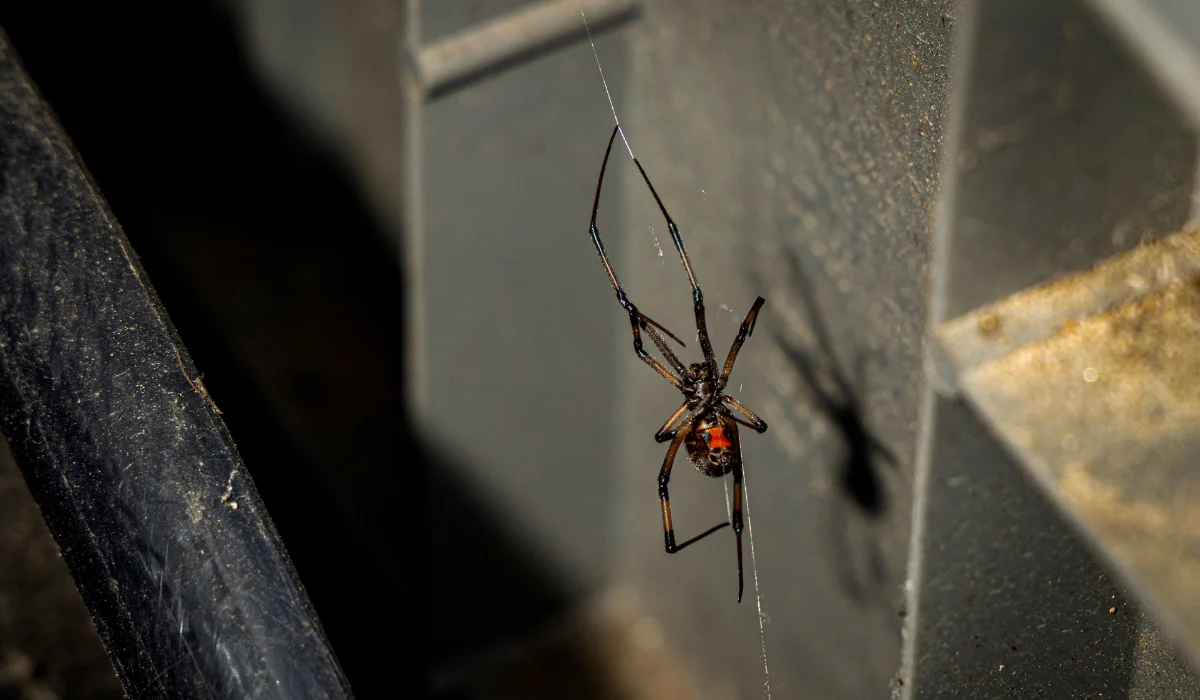
Black widow spiders in early fall often go unnoticed around San Diego homes because they settle in sheltered places people rarely inspect closely. Garages, irrigation boxes, patio furniture, sheds, and outdoor storage can all provide protected spots for a web. Knowing where to look, how to recognize widow webbing, and how black widows differ from brown widows can help you avoid accidental contact and decide when repeated activity needs professional attention.
Where Black Widow Spiders in Early Fall Hide Around San Diego Homes
Black widow spiders in early fall are most worth checking for in areas that stay sheltered and relatively undisturbed. The UC Statewide Integrated Pest Management Program describes widow spiders as occupants of protected locations around buildings and other structures.
That behavior gives homeowners a practical way to inspect. Rather than looking only for a spider sitting in the open, check recesses, undersides, corners, storage areas, and covered enclosures where a web can remain in place.
Garages and Stored Items
Garages provide many black widow spider hiding places because boxes, shelving, tools, sports equipment, and other belongings may sit untouched for weeks or months. Areas beneath workbenches, behind shelving, around cabinets, and along the edges where walls meet the floor can be easy to overlook.
Before reaching behind a box or picking up something that has been stored for a while, inspect the area around it first. Webbing attached to the back or underside of an object may be difficult to see from the front.
Keeping storage off the floor when practical and avoiding tightly packed clutter also makes inspection easier. The goal is not to make a garage spider-proof. It is to reduce concealed spaces where activity can continue without being noticed.
Irrigation and Utility Boxes
Irrigation boxes deserve extra attention around San Diego properties. They stay covered most of the time and may only be opened when someone adjusts a valve, checks a leak, or corrects an irrigation problem.
That limited disturbance can create a suitable hiding place for widow spiders. Before placing a hand inside, lift the cover carefully and look around the interior, edges, and valves.
Other utility enclosures can create similar conditions. The box itself is not what attracts a black widow. The sheltered recess and lack of frequent disturbance are what make these areas worth checking.
Patio Furniture and Outdoor Living Areas
San Diego homeowners often continue using patios and outdoor seating through early fall. The tops of chairs and tables may get regular use while the undersides remain almost untouched.
Check beneath chairs, tables, storage benches, grills, and other outdoor fixtures before moving them. A spider can remain hidden underneath a surface even when the furniture looks clear from above.
Furniture or equipment that has stayed in one position deserves the closest look. The back of a storage bench, underside of a table, or protected area beneath an outdoor cooking station can conceal webbing that is easy to miss during normal use.
Sheds, Outdoor Storage, and Exterior Gaps
Sheds create many of the same hiding opportunities as garages. Garden tools, storage containers, flowerpots, lumber, and equipment can provide sheltered edges where webbing stays undisturbed.
Protected recesses around block walls, retaining walls, and exterior features can also support widow activity. What these locations share is cover and low disturbance, not a particular construction material.
| Area to Check | Why It Deserves Attention | What to Look For |
|---|---|---|
| Garage corners and shelving | Stored items may remain untouched | Irregular webbing behind or beneath objects |
| Irrigation and utility boxes | Covered recesses are opened infrequently | Webbing around edges, valves, or covers |
| Patio furniture | Undersides receive little disturbance | Tangled webbing below chairs, tables, and benches |
| Sheds and outdoor storage | Tools and containers create concealed spaces | Webbing along walls, boxes, and equipment |
| Exterior recesses | Narrow spaces provide shelter | Persistent webbing inside protected gaps |
| Children’s climbing structures and toys | Many elevated, protected, and hidden locations for webs | Tangled webs beneath slides, under raised platforms and rolled edges of plastic play structures |
Why Black Widow Spiders Choose Sheltered Areas
Black widows use webs to capture prey, so a location where the web can remain intact has an advantage. That helps explain why widow spiders are associated with quiet corners, covered recesses, stored objects, and the undersides of outdoor items rather than frequently cleaned or exposed surfaces.
The web itself is an important inspection clue. Black widow webs are irregular and tangled rather than the neat, circular webs made by orb-weaving spiders. A messy web does not identify a black widow by itself, but web structure and location can tell you where to look more carefully.
Nearby insect activity also plays a role. A web is useful when prey moves through it, which means recurring spider activity may coincide with areas where insects are present. Homeowners who are unsure whether a spider is a widow or one of the harmless house spiders commonly found around San Diego should rely on more than color or location alone.
Why Black Widow Spiders in Early Fall May Suddenly Get Noticed
Black widow spiders in early fall may seem more noticeable when homeowners start disturbing areas that have been left alone. Moving patio furniture, reorganizing a garage, opening a storage container, or checking an irrigation box can expose an established web.
Finding a widow spider in September or October does not prove that it recently moved into the area or that San Diego has reached a specific black widow population peak. Without reliable local data supporting a precise seasonal peak, it is better to focus on what homeowners can observe.
The useful seasonal point is simple: if early fall has you moving stored items, working in the yard, or checking outdoor equipment, wear gloves and inspect before putting your hands into spaces you cannot see clearly.
How to Identify a Western Black Widow
The western black widow, Latrodectus hesperus, occurs in California and is the black widow species most relevant to San Diego homeowners. Identification should involve more than seeing a dark spider.
Adult females are the form people most commonly associate with the name black widow. Their appearance, markings, web, and location can all help with identification, but a single feature should not be treated as definitive when the spider is difficult to see.
Look at the Web, Not Just the Spider
A black widow spider web looks different from the familiar wheel-shaped web stretched between plants or across a walkway. Widow webs are irregular and tangled, often extending from a sheltered retreat.
That makes the web useful during an inspection. If tangled webbing keeps appearing beneath a shelf, around an irrigation enclosure, or under patio furniture, inspect the protected area connected to the web rather than simply brushing away the visible strands.
Removing a web may clear the immediate area, but it does not tell you whether the spider is still nearby or whether the location continues to provide good shelter.
Black Widow vs. Brown Widow
Brown widows also occur around structures in California, so homeowners may confuse them with black widows. UC Riverside Entomology provides university-based information on widow spider biology and identification.
Color by itself can be misleading, especially across different life stages. Markings, body appearance, web placement, and egg sacs can provide additional clues when distinguishing widow species. Thrasher’s guide to brown widow spider identification in San Diego also explains the local identification differences homeowners may encounter around houses and outdoor structures.
Brown widow bites are infrequently reported as severe and are generally considered less medically significant than black widow bites. That does not make handling a brown widow a good idea. If you are unsure which widow spider you found, avoid contact and have the activity identified.
What to Do When You Find a Black Widow Spider
If you find a black widow or a web that may belong to one, avoid reaching directly into the hiding place. Take note of the location and inspect nearby protected areas visually before moving boxes, furniture, tools, or outdoor equipment.
Accidental contact is a more practical concern than the idea of a widow spider chasing or pursuing a person. A spider hidden beneath an object can be pressed against the skin when that object is grabbed or moved without being checked first.
Use a flashlight when visibility is poor, and look before reaching into irrigation boxes, storage areas, cluttered corners, or spaces behind equipment. Gloves can reduce direct skin exposure while handling stored items, but they are not a substitute for checking the area first.
If someone may have been bitten, use a medical source rather than relying on pest-control advice. The California Poison Control System provides guidance for poison exposures and can help determine appropriate next steps based on the circumstances.
How Thorough Black Widow Spider Control Works
Black widow spider control should start with an inspection. Removing the spider someone sees may address that individual, but it does not show whether additional webs, egg sacs, or hiding areas are present nearby.
An inspector can examine active webbing, storage areas, exterior recesses, utility enclosures, patio furniture, and other protected spaces. The inspection also looks at conditions that may be allowing recurring spider activity around the structure. A more complete spider control service in San Diego focuses on both visible activity and the sheltered areas where spiders are establishing webs.
Thrasher’s Home Pest Protection includes spiders, including black widow spiders. The company also gives its inspectors time to examine a property carefully instead of packing each route with the 20 to 25 daily stops common at some larger companies. That extra inspection time matters when the visible web may lead to a spider concealed behind storage, beneath furniture, or inside another protected area.
Prevention works best when it is tied to what the inspection finds. Keeping stored belongings organized, reducing unnecessary clutter against exterior walls, checking patio furniture before moving it, and inspecting covered utility spaces can make hidden spider activity easier to detect.
Addressing Black Widow Spiders Around Your San Diego Home
Black widow spiders in early fall are easier to deal with when you know which areas deserve a closer look. Garages, irrigation boxes, patio furniture, children’s climbing structures and toys, sheds, storage spaces, and protected exterior recesses can conceal both the spider and the web until those areas are disturbed.
If black widow activity keeps shochildren’s climbing structures and toyswing up around your property, Thrasher Pest Control can inspect the areas where spiders are hiding and recommend a treatment and prevention approach based on what is actually present. Thrasher serves Poway, Carlsbad, Chula Vista, El Cajon, San Marcos, La Mesa, Rancho Santa Fe, and surrounding San Diego County areas. You can contact Thrasher Pest Control to schedule an inspection for recurring black widow activity.