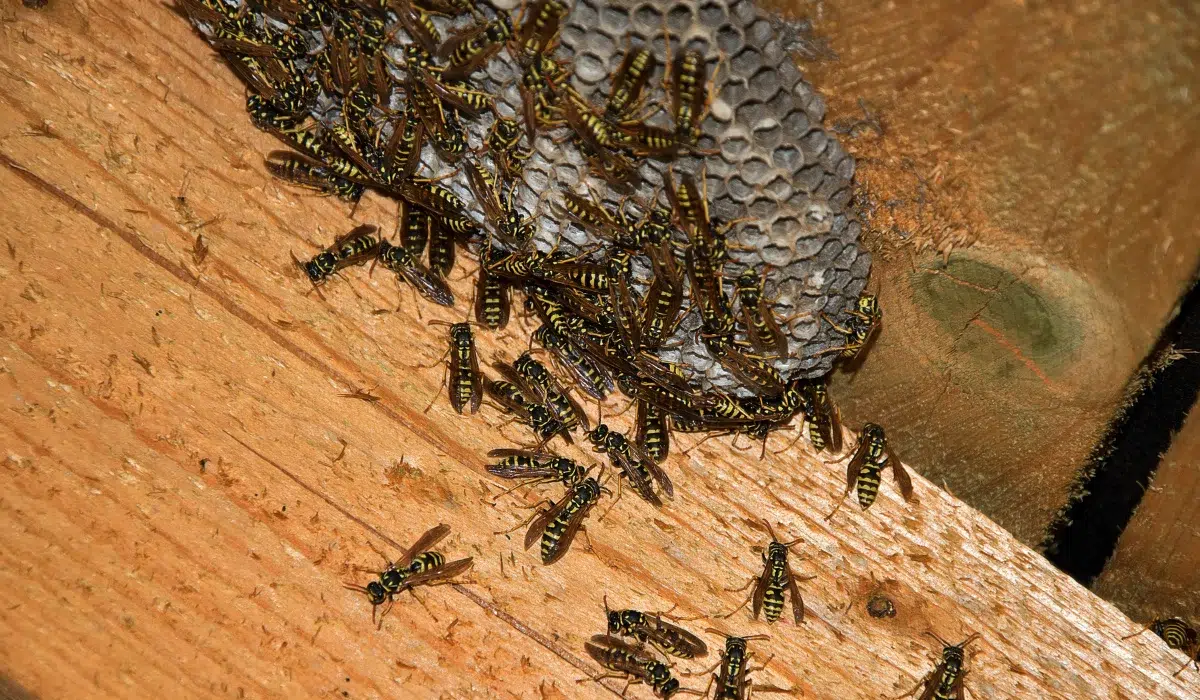
San Diego yards can attract several stinging insects, including yellowjackets, paper wasps, mud daubers, and bees. Some are mostly a nuisance when they forage around food or flowers. Others become a problem when they build nests near patios, play areas, rooflines, vents, sheds, or other high-traffic spaces.
If you are dealing with stinging insects in San Diego yards, the first step is to watch where they are coming from. Repeated flight into the same hole, wall gap, eave, shrub, lawn area, or ground opening usually means there is a nest nearby. Do not disturb it to confirm.
Key Takeaways
- Yellowjackets and paper wasps are common social wasps in California.
- Yellowjackets are very defensive in general and especially around nests.
- Paper wasps often nest under eaves and patio covers.
- Bees that have established hives in or near homes can pose a danger to people.
- Call for help when a nest is active near people, pets, or home entry points.
Yellowjackets
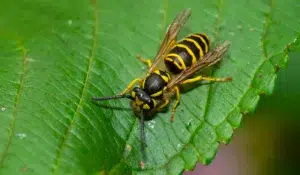
Yellowjackets are one of the most concerning stinging insects around San Diego yards because they are attracted to human food, especially sugary drinks and meat. They approach people without fear and if you swat at them, they will attack. They can sting multiple times and release a pheromone that attracts other yellowjackets in the area to join the attack. They also aggressively defend their nests when disturbed. They may nest in ground holes, wall voids, ceiling voids, or other protected cavities. Many people have accidentally disturbed a nest when gardening and suffer multiple stings.
You may notice yellowjackets around:
- Lawn areas
- Ground openings
- Wall gaps
- Trash cans
- Outdoor food
- Pet food bowls
- Fruit trees
- Patios and barbecue areas
UC IPM explains that yellowjackets are the most troublesome social wasps in Western states, especially ground- and cavity-nesting species. Activity can become more noticeable later in the season when workers forage around sweets, garbage, and outdoor food.
If yellowjackets are entering a hole in the ground or a wall gap, do not seal it. Blocking an entrance can push activity into a structure or make the insects more defensive.
Paper Wasps
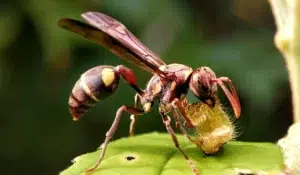
Paper wasps are common around rooflines, patio covers, shade umbrellas, fence rails, and eaves. Their nests are usually open-cell, paper-like structures that hang from a protected surface.
Paper wasps are often less defensive than yellowjackets, but they can sting if their nest is disturbed. A nest near a door, window, balcony, outdoor kitchen, or play area should be taken seriously because people may pass too close without noticing it.
Signs of paper wasps include:
- Wasps hanging under eaves or patio covers
- Open-cell nests with visible hexagon-shaped cells
- Repeated flight to one roofline or overhang
- Activity near sheds, pergolas, or deck framing
If the nest is small but active, avoid knocking it down. Nest removal should happen only after the activity is addressed.
Mud Daubers
Mud daubers are solitary wasps that build small mud nests on walls, under eaves, in garages, or on sheltered outdoor surfaces. They are usually less aggressive than social wasps because they do not defend a large colony in the same way yellowjackets do.
A mud dauber nest may look like a small mud tube or cluster of dried mud. These nests can be messy, especially around stucco, garage walls, and covered patios.
Mud daubers can still sting if handled or trapped, so it is best not to grab, scrape, or crush active nests by hand. If you are seeing repeated wasp activity around several mud nests, we can inspect the area and confirm what type of wasp you are dealing with.
Bees
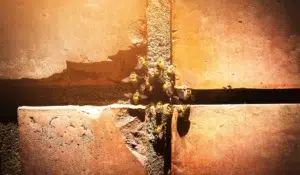
Bees are common in San Diego yards, especially near flowering plants, irrigation, wall cavities, roof gaps, and outdoor structures. Foraging bees around flowers are usually different from an active colony inside a wall, tree cavity, meter box, subarea or roofline.
The County of San Diego says it does not remove feral honey bee colonies from private property and recommends contacting a licensed pest control company or live bee removal company instead of trying to remove bees yourself. That local guidance matters because bees can become agitated when a colony is disturbed.
Watch for:
- Steady bee traffic into a wall or roof opening
- A buzzing sound from a cavity
- Bees gathering around a meter box, shed, or tree hollow
- Large numbers of bees around one entry point
- Bees appearing indoors near lights or windows
Our bee control services in San Diego start with locating the nest or activity area, checking common nesting spots, and helping you understand what type of bee problem is present.
Where Stinging Insects Nest Around San Diego Homes
San Diego yards offer many protected nesting spots. Warm weather, outdoor dining, irrigated landscaping, and open structures can make activity more noticeable around the home.
Common nesting areas include:
- Eaves and soffits
- Patio covers and pergolas
- Wall gaps and vents
- Ground holes (often from gophers or moles)
- Shrubs and hedges
- Sheds and play structures
- Fence posts and deck framing
- Meter boxes and utility areas
- Tree cavities or hollow spaces
The nest location matters. A paper wasp nest under a far fence line may be less urgent than yellowjackets entering a ground hole beside a walkway. A bee colony inside a wall needs a different response than bees foraging on flowers.
What To Do When You Find A Nest
If you find an active nest, keep your distance and watch the flight path. Most stinging insect problems become more dangerous when someone tries to spray, seal, hit, or remove the nest without understanding colony behavior.
A safer approach is to:
- Keep children and pets away from the area.
- Avoid mowing, trimming, or using loud tools nearby.
- Do not seal entry holes while insects are active.
- Cover trash, food, drinks, and pet food outdoors.
- Take photos from a safe distance to share with pest control professionals..
- Schedule service if the nest is near people or entry points.
If anyone has a known sting allergy, avoid the area and call for professional help sooner.
How We Handle Stinging Insects
Our wasp control services in San Diego begins with a property inspection. We look for nests around eaves, soffits, overhangs, wall gaps, yard structures, and other common nesting areas.
Once we locate the active nest, we treat the source directly. We also check nearby areas where new nests may be forming or where activity is likely to return. The goal is to address the active problem and help reduce repeated activity around the home.
For bee activity, we inspect the nesting area, identify the type of activity, and recommend the right next step based on location and safety.
When To Call For Stinging Insect Control
Call for help when stinging insects are nesting near people, pets, doors, patios, decks, garages, or play areas. You should also schedule service if activity is coming from a wall, roofline, ground hole, or enclosed cavity.
Professional control makes sense when:
- Wasps or bees are using one active entry point.
- The nest is high, hidden, or hard to reach.
- Activity is near doors, outdoor seating, or walkways.
- Someone in the home has a sting allergy.
- You are unsure whether you have bees, wasps, or yellowjackets.
- DIY spraying has not stopped the activity.
A proper inspection helps identify the insect, locate the nest, and choose the safest treatment path.
Schedule Stinging Insect Control In San Diego
If stinging insects are active around your yard, patio, roofline, or outdoor living space, we can inspect the area and recommend the right service for your home.
Contact us to schedule stinging insect control in San Diego.
Frequently Asked Questions
What Are The Most Common Stinging Insects In San Diego Yards?
Common stinging insects include yellowjackets, paper wasps, and bees. All of these social insects will sting to protect their nests.
How Can I Tell If I Have Yellowjackets Or Paper Wasps?
Yellowjackets often nest in ground holes, wall voids, or other cavities and can be more defensive. Paper wasps usually build open-cell nests under eaves, patio covers, shade umbrellas, fences, or overhangs.
Should I Remove A Wasp Nest Myself?
We do not recommend disturbing an active nest, especially near doors, patios, walls, or ground openings. Spraying, knocking down, or sealing a nest can make the insects defensive.
Are Bees Treated The Same As Wasps?
No. Bee activity should be handled carefully, especially when bees are nesting inside a wall, roofline, meter box, or tree cavity. The right response depends on the species, location, and level of activity.
When Should I Call For Professional Help?
Call when the nest is active, close to people or pets, hidden inside a structure, difficult to reach, or causing repeated activity around outdoor living areas.