
Understanding Your WDO Report
Information Series
The WDO Report, or Wood Destroying Pests and Organisms Inspection Report, format is specified by the California Structural Pest Control Board (SPCB) and may not be the easiest document to read or understand. The information on this page will help you understand unfamiliar terms in the report and the various recommendations.
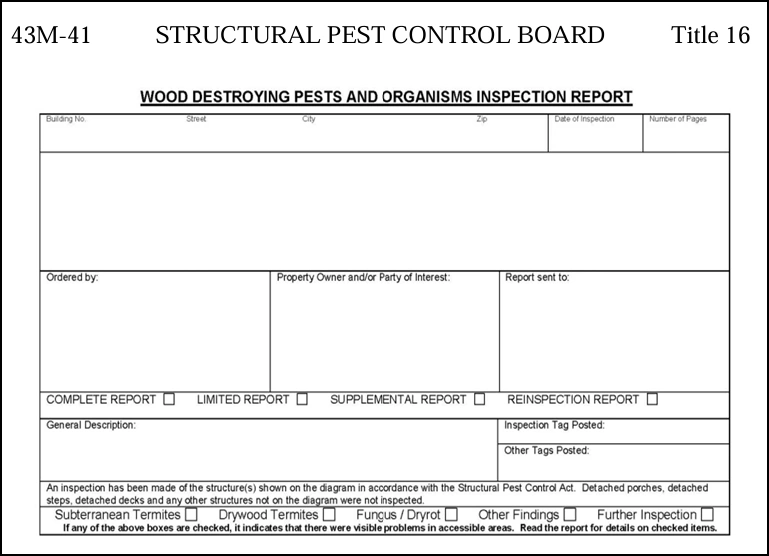
WDO Report Definitions
WDO
Short for for Wood Destroying Organism
Short for for Wood Destroying Organism
Wood Destroying Organisms defined by the Structural Pest Control Act:
- All termites: drywood, subterranean, Formosan subterranean, and dampwood
- Wood destroying fungus/dryrot
- Carpenter bees
- Carpenter ants
- Wood-boring beetles
Structural Pest Control Act
IMPORTANCE: Legal statute that governs the operations of termite and pest control businesses
IMPORTANCE: Legal statute that governs the operations of termite and pest control businesses
Pest control is a highly regulated industry. the Structural Pest Control Act contains the rules that all businesses that perform pest control services must follow. The Structural Pest Control Board is the entity that enforces the Act. It is under the California Department of Consumer Affairs. If you have an issue with a pest control company or any contractor that you can’t work out, contact the Department of Consumer affairs.
Section I Items
IMPORTANCE: A Section I item means that something is actively destroying the structure or has already left damage behind.
IMPORTANCE: A Section I item means that something is actively destroying the structure or has already left damage behind.
“Section I items” is shorthand for items where there is visible evidence of active infestation, infection OR conditions that have resulted in or from infestation of infection.
“Active” means active termites or growing fungus.
“Conditions that have resulted” means wood damage that has resulted from infestation or infection EVEN when the infestation or infection is no longer active.
How can wood be infected? It may be infected by fungus.
Section I Items are the items that are the most important to address. They are so important that most lenders will not authorize a loan unless the property has a “Section I clearance,” meaning all items designated as Section I have been remedied.
Examples of Section I Items:
- Winged termites flying out of wood trim means a termite is alive and eating the wood of the structure.
- Piles of termite pellets occur when drywood termites need more room in their tunnels and push out dried, digested wood.
- Wood that is checked, or spongy indicates a fungus infestation. Sound wood is not spongy.
Section II Items
IMPORTANCE: Section II Items left uncorrected put a structure at risk of damage.
IMPORTANCE: Section II Items left uncorrected put a structure at risk of damage.
Section II items are conditions deemed likely to lead to infestation or infection but where no visible evidence of such was found.
Examples of Section II items:
- A leaky seal around a toilet that lets water into the wood subfloor. The leak may not have led to fungus or dryrot yet, but creates an ideal environment for fungus.
- Unpainted wood trim. When mated pairs of drywood termites look to set up a new colony, unpainted wood is easy for them to infiltrate.
- Wood mulch against the foundation provides both a feast and a highway for subterranean termites to enter a structure.
Further Inspection
IMPORTANCE: Identifies areas that could not be inspected and may be at risk.
IMPORTANCE: Identifies areas that could not be inspected and may be at risk.
Further inspection items are defined as recommendations to inspect area(s) which during the original inspection did not allow the inspector access to complete the inspection and cannot be defined as Section I or Section II.
Example:
A garage that is full of stored items may not allow the WDO inspector to reach the walls. Once the storage is cleared, they recommend a “further inspection” meaning taking a look at the now cleared area.
Inaccessible areas
IMPORTANCE: WDO Inspectors do not have x-ray vision and can miss a problem they can't reach.
IMPORTANCE: WDO Inspectors do not have x-ray vision and can miss a problem they can't reach.
According to the Structural Pest Control Act, portions of a structure that are not available for visual inspection must be designated as inaccessible. WDO inspectors are limited by what they can see and touch. There are usually areas of a structure that are inaccessible. These areas are not listed as “further inspection” because they will never be accessible; it’s not a matter of moving a box or two. Because these areas cannot be visually inspected, they are noted so that the property owner knows those areas may be at risk.
Examples:
- A subarea that is not high enough to allow a person to crawl inside.
- The portion of a building cantilevered over a canyon may be too dangerous to inspect without specialized equipment.
Recommendations Preserve and Protect Your Property
- ➡️ Subterranean Termite Complete Perimeter Treatment
- ➡️ Subterranean Termite Baiting
- ➡️ Subterranean Termite Local Treatment
Perimeter Treatment
Complete perimeter treatment (barrier treatment) for subterranean termites involves applying a liquid termiticide around the house to achieve a continuous treatment zone.
- In order to reach the soil, treatment may include drilling through exterior concrete abutments such as porches, patios, walkways, and sidewalks. Drilling is done using a ½” drill bit. The holes are injected with a liquid termiticide. The holes are plugged with rubber plugs and patched with cement. There will be noticeable drill holes and patch marks.
- In areas where soil abuts the house, we trench the soil to a depth of 2- to 6-inches, treat the area with a liquid termiticide, and backfill the treated areas.
- Treatment does not repair wood damage. Treatment does not target drywood termites or other wood destroying organisms.
- The limited warranty for complete perimeter treatment is two years. If live subterranean termites reemerge in a previously treated area, we will re-treat that area. See the contract for full terms and conditions.
Baiting
Subterranean Termite Baiting involves installation of bait stations in the soil around the perimeter of the house.
- Termite baits consist of cellulose (a structural component of wood) combined with a slow-acting insecticide which disrupts the normal growth process in termites. Within weeks of ingesting the bait, termites die while attempting to molt.
- Baiting is a year-round service. Bait stations must be monitored for activity and the bait must be refilled.
- Treatment does not repair wood damage. Treatment does not target drywood termites or other wood destroying organisms.
- See the contract for full terms and conditions.
Local Treatment
- Local treatment for subterranean termites may involve drilling through exterior concrete abutments or trenching and treating the soil. See the above description of these procedures.
- Local treatment of interior infestations may include injecting foam termiticide into a wall void. Thrasher technicians will seal holes after localized treatment. If you supply the paint, we will touch up areas after treatment.
- Local treatment does not repair wood damage. It is not a treatment of the entire house. Treatment does not target drywood termites or other wood destroying organisms.
- The limited warranty for local treatment is one year in the area(s) treated. If live subterranean termites reemerge in a previously treated area, we will re-treat that area. Termites discovered in another area are not covered by the limited warranty. See the contract for full terms and conditions.
Fumigation
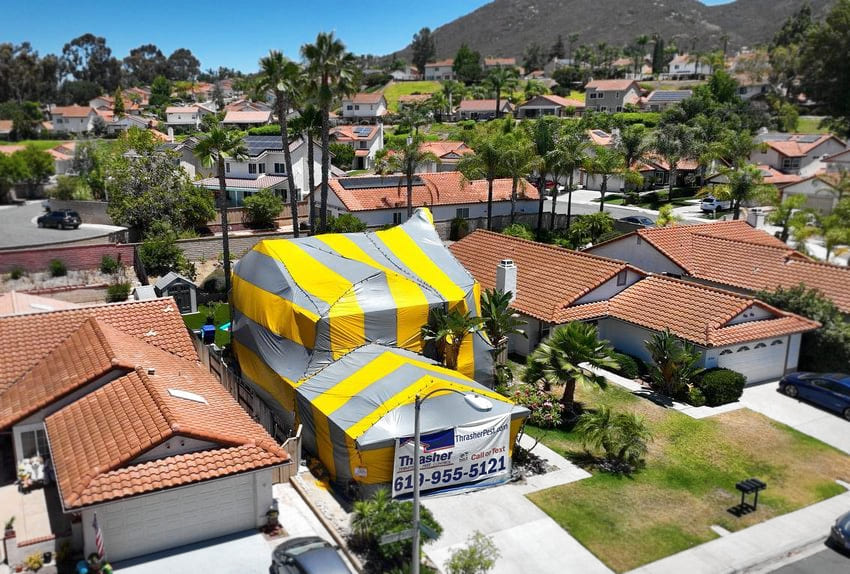
Whole-structure fumigation kills all drywood termites, even hidden or inaccessible colonies. One treatment eliminates 100% of drywood termites.
- There is no residual material left in the home.
- Fumigation is usually two nights and three days.
- A fumigation coordinator is assigned to your project after the agreement is signed. You are also provided with a Fumigation Preparation Guide to help plan and prepare for fumigation.
- Fumigation does not repair wood damage. Treatment does not target subterranean termites or other wood destroying organisms.
- The limited warranty for fumigation is two years. If live termites reemerge in a fumigated area, we will re-treat that area. See the contract for full terms and conditions.
Local Treatment
Local treatment for drywood termites involves drilling and injecting termiticide into the infested areas noted on the WDO report. The recommended treatment area(s) will be outlined in the contract.
- Thrasher technicians will seal the interior and/or exterior holes after localized treatment. If you supply the paint, we will touch up areas after treatment.
- Local treatment does not repair wood damage. It is not a whole house treatment method. Treatment does not target subterranean termites or other wood destroying organisms.
- The limited warranty for local treatment is one year in the area(s) treated. If live termites reemerge in a previously treated area, we will re-treat that area. Termites discovered in another area are not covered by the limited warranty. See the contract for full terms and conditions.
Evidence Removal
- Removal involves sweeping or vacuuming pellets, or when that is not possible, masking or dusting the pellets with a non-toxic powder to identify them as old termite evidence.
- Evidence removal does not repair wood damage. It is not a treatment for termites or other wood destroying organisms.
- ➡️ Drywood Termite Fumigation
- ➡️ Drywood Termite Local Treatment
- ➡️ Drywood Termite Evidence Removal
- ➡️ Fungus Treatment
- ➡️ Wood Damage Repair
- ➡️ Termite Prevention for Construction
Fungus Treatment
- Wire brush treatment for fungus is a standard surface treatment.
- Thrasher technicians scrape fungus and loose decay off the surface of wood using a wire brush. Afterward, material is applied to the wood to prevent further fungus damage in that area.
- Surface fungus treatment does not repair wood damage. It is not a treatment for termites or other wood destroying organisms.
- The limited warranty for surface treatment is one year in the area(s) treated. If fungus reappears in a previously treated area, we will re-treat that area. Fungus discovered in another area is not covered by the limited warranty. See the contract for full terms and conditions.
Damage Repair
- Damage repair is a specialty of Thrasher Pest Control. We are licensed to repair all damage caused by wood destroying organisms—from a single trim board to an entire bathroom or large deck. We can repair or replace doors, windows, joists, subfloors, wallboard, flooring including tile and vinyl, and install showers, tubs, cabinets, and sinks. We are licensed to repair anything that has been compromised by a wood destroying organism (termites, fungi, dry-rot, beetles) or can lead to infestation (water damage, insufficient ventilation, etc.)
- Repair involves removal of the damaged material and replacement with sound material that meets the same form and function. Doors and trim will be matched to the original whenever possible.
- Repairs are performed by in-house skilled carpenters. After repair, areas that were previously painted (such as siding and trim) will be painted. An exact paint match of repaired areas cannot be guaranteed due to weathering and fading.
- Only the specific items agreed to in the contract will be repaired. Damage repair is not a treatment for termites or other wood destroying organisms.
- The limited warranty for repair workmanship is one year. See the contract for full terms and conditions.
Prevention
- Pre-construction Preventative Termite Treatment involves applying a termiticide to all available surfaces of structural wood BEFORE electrical, insulation, and finish work are started.
- Pre-construction Preventative Subterranean Termite Treatment involves drilling and injecting termiticide into the soil surrounding each structure on the building site after grading, but before the foundation is poured.
- See the contract for full terms and conditions.
WDO (Termite) Inspections
All termite inspections are performed by a licensed, experienced inspector and followed by a written report. Our inspector will note wood-destroying organisms: drywood termites, subterranean termites, dampwood termites, fungus/dry rot, wood-boring beetles, carpenter ants, and carpenter bees.
The WDO report includes a list of damage found, conditions that put the structure at risk, recommendations for treatment and repair, and recommendations for preventing conditions that make your home vulnerable to termites and other wood destroying organisms.
Termite Control and Treatments

Termite Treatments
Local Termite Treatment
When termites or dry rot is confined to one or two areas, the structure may be a candidate for local treatment. This means only the visible, affected area is treated. The Thrasher Inspector will advise you if local treatment is a good option for your structure and provide alternatives if it is not.
Termite Treatments
Drywood Termite Fumigation
The primary recommendation for the treatment of drywood termites is fumigation. By the time evidence of drywood termites becomes visible, there is a high likelihood of multiple colonies in the structure. Fumigation is the proven method of exterminating all drywood termites. Learn more about structural fumigation.
Termite Treatments
Subterranean Termite Treatments
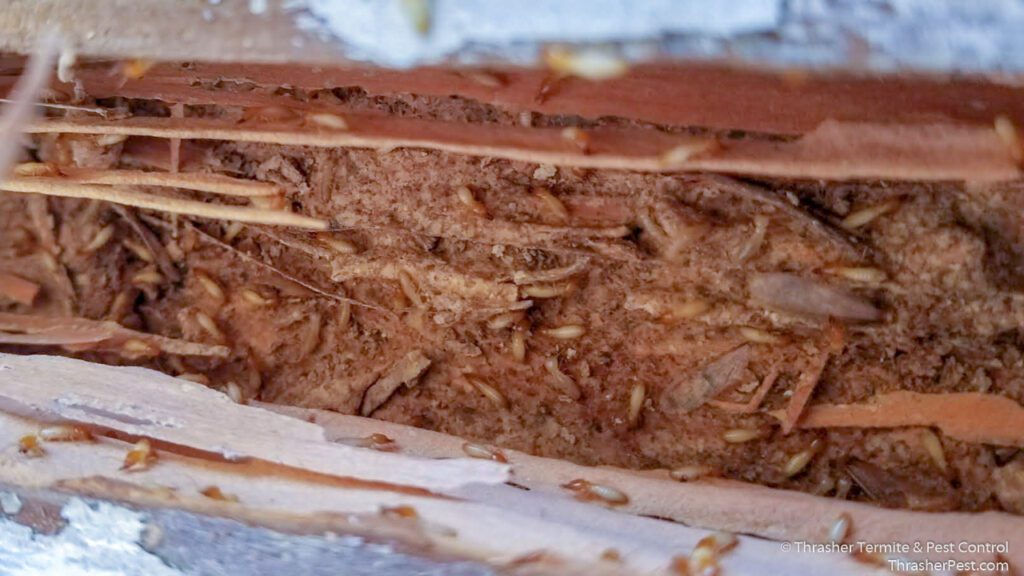
Subterranean termites and Formosan subterraneant termites are controlled through perimeter soil treatments, baiting with monitored bait stations, or both. The treatment we prescribe takes into account the subterranean termites species, the infestation’s size, the landscape around your home, and your goals.
Repair Termite and Wood Damage
Thrasher master carpenters are skilled at repairing wood damage. We are licensed to perform structural repairs and to manage projects as complex as complete bathroom to kitchen remodels. We’re licensed and bonded. Just as with our termite control service, we perform the least invasive repair remedy for problem areas in your home. Remember, after your home is treated for termites or dry rot, it is essential to repair damaged areas to prevent re-infestation and to prevent secondary problems.